Stop board warping and cover bubbling on case makers: high-solids low-moisture glue, open time for air release, grey board caliper (1.5–4.0 mm), humidity discipline, and foil/cloth wrap qualification—without treating marketing claims as universal guarantees.
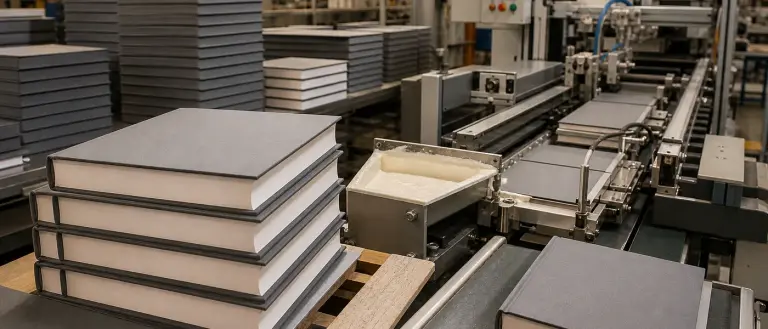
Table of Contents
Hardcover warping is rarely “bad glue” in isolation. Grey board picks up uneven moisture from a high-water adhesive, trapped air under wrap creates tunnels, and corners lift when open time is too short for positioning. Case-making teams fix warping by balancing moisture transfer, machine timing, and substrate prep—not by raising coat weight alone.
Diagnose the Failure Mode First
- Cupping / bowed board: often uneven fiber swelling from moisture—check adhesive solids and plant humidity.
- Bubbles or tunnels under cloth/paper: air entrapment or skinning before positioning—open time and roller cleanliness.
- Corner lift on foil or soft-touch: LSE surface wet-out—do not assume the same grade works on plain paper wrap.
Moisture-Controlled Adhesive Selection
Our hardcover cluster positions high-solid, low-water formulations to limit board tension during cure. Matrix copy cites 1.5–4.0 mm grey board and viscosity roughly 1,500–6,000 cps for roller application on automated casemakers—always map to your Kolbus/Horauf-class cycle and board lot.
Validate flatness on your cover wrap after conditioning; page marketing language about “100% flatness” is a qualification target, not a substitute for plant trials.
Open Time, Air Release, and Line Speed
Formulation tables list adjustable open time in roughly the 2–10 second window with case-maker speeds cited up to 60+ cases/min on equipment names on our page—increase speed only after corners stay sharp and bubbles do not return on the next humidity swing.
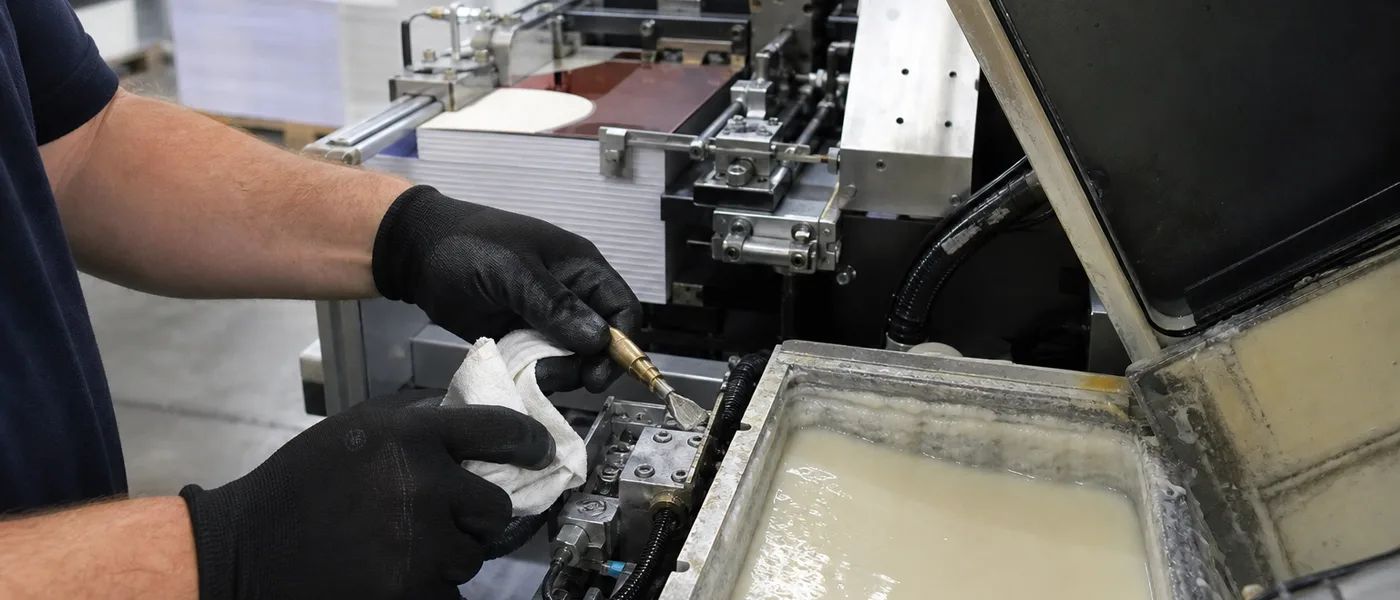
- Clean rollers and glue trays on interval—buildup mimics “warping” when laydown becomes uneven.
- Log ambient RH and board storage moisture; summer warehouses expose weak moisture-control grades quickly.
Wrap Material: Paper, Cloth, Foil, Leather
High-GSM decorative end sheets need low-moisture routes to avoid bleed-through warping. Foil and soft-touch laminates need wetting agents that bite LSE surfaces—see print finishing qualification when launches include textured or silk overwraps.
Warping or Bubbling on Your Casemaker?
Review hardcover grades for anti-warp moisture control, foil/cloth wrap, and Kolbus/Horauf-class line speeds.
Hardcover & Case MakingCasing-In vs. Case Making
- Case making: wrap adhesion, anti-warp, corner definition on grey board shells.
- Casing-in: joint flexibility and permanent block attachment—different viscosity and open-time needs.
- Do not use one pot viscosity for both stations without screening pull and lay-flat separately.
Spine chemistry for flex cycles is covered in PUR perfect binding optimization when the program includes integrated bindery lines.
Compliance for Gift and Children’s Formats
Hardcover programs may need FDA 21 CFR 175.105 for indirect food-contact gift boxes, EN 71-3 for children’s books, and REACH/RoHS for EU export—bundle declarations with TDS during vendor onboarding.
Field Evidence
A premium case-making converter reduced board warp, bubbling, and corner-lift pressure with a lower-moisture program—details in the anti-warp case study. Customer QA feedback in our application guide cited about 15% lower rejection after jelly-glue alignment—treat as trial outcome, not a universal guarantee.
Startup Checklist
- Measure board caliper and store boards in controlled RH before wrap.
- Record pot temperature, viscosity, and coat weight at shift start.
- Run bubble check on worst-case foil/cloth lot before speed-up.
- Condition finished cases 24–48 h before flatness sign-off (plant-specific).
- Request 20 kg trial pail for casemaker validation (1,000 kg MOQ for production per page FAQ).
Final Takeaway
Anti-warp case making is moisture discipline plus machine timing. Select high-solids chemistry, give air time to escape, and qualify every wrap type on your board lot. Send photos of cupped panels, bubble maps, and machine OEM/speed for structured grade screening.
Frequently Asked Questions
Why does grey board warp after wrapping?
Uneven moisture uptake from the adhesive swells fibers on one side. High-water glues are a common trigger—our cluster emphasizes high-solid, low-moisture routes validated on roughly 1.5–4.0 mm board in customer programs.
How do I stop bubbles under cloth or paper covers?
Extend effective open time for air release, keep rollers clean, and avoid skinning before the wrap is positioned. Speed increases only after bubble-free runs on your humidity worst case.
Will the same glue work on foil-laminated covers?
Foil and soft-touch films are low-energy surfaces—qualify wet-out and corner hold separately from plain paper wraps; decorative-wrap programs may need additional sensory and compliance review.
What MOQ applies to hardcover adhesives?
Standard industrial MOQ is about 1,000 kg on our page, with 20 kg trial units for machine validation—confirm with applications engineering for your region.
Trial case-making adhesive on your line
Request complimentary 1 kg lab material (shipping prepaid by recipient) after screening on your substrate and line conditions.
References
Technical Disclaimer: All technical data is based on standard laboratory conditions. Users should perform their own verification testing to confirm suitability for specific substrates, processes, and regulatory requirements. Senda Glue makes no warranties, express or implied, and assumes no liability for improper use of the products or reliance on this information.