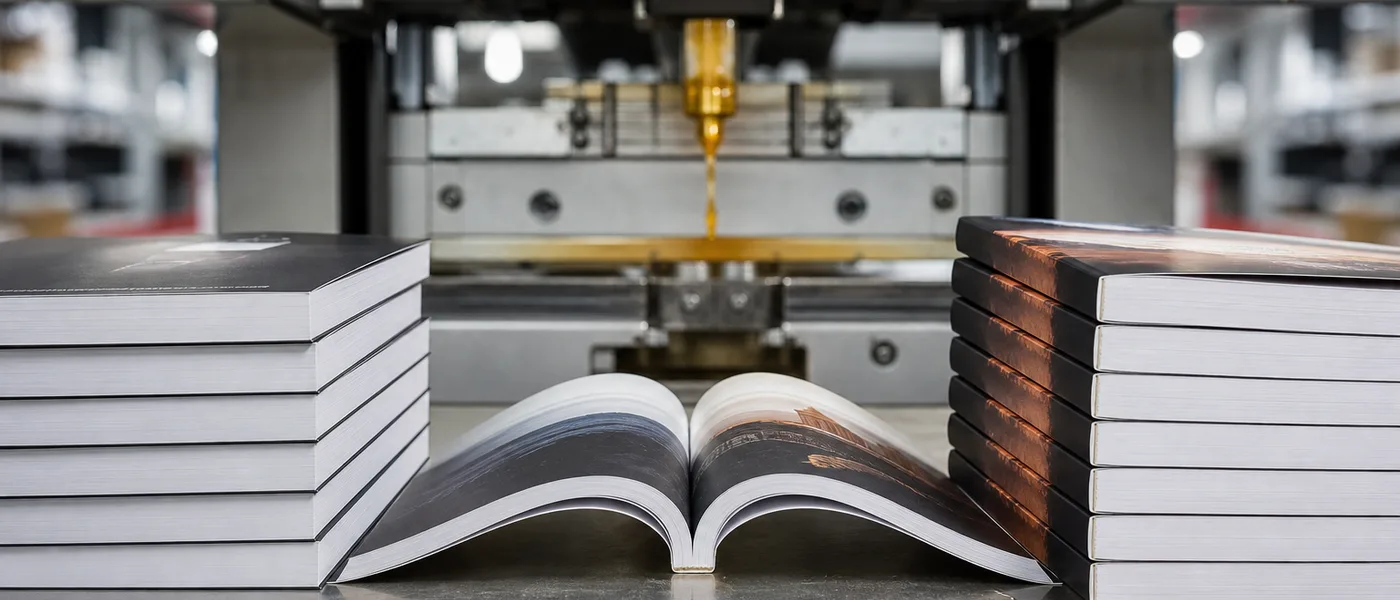
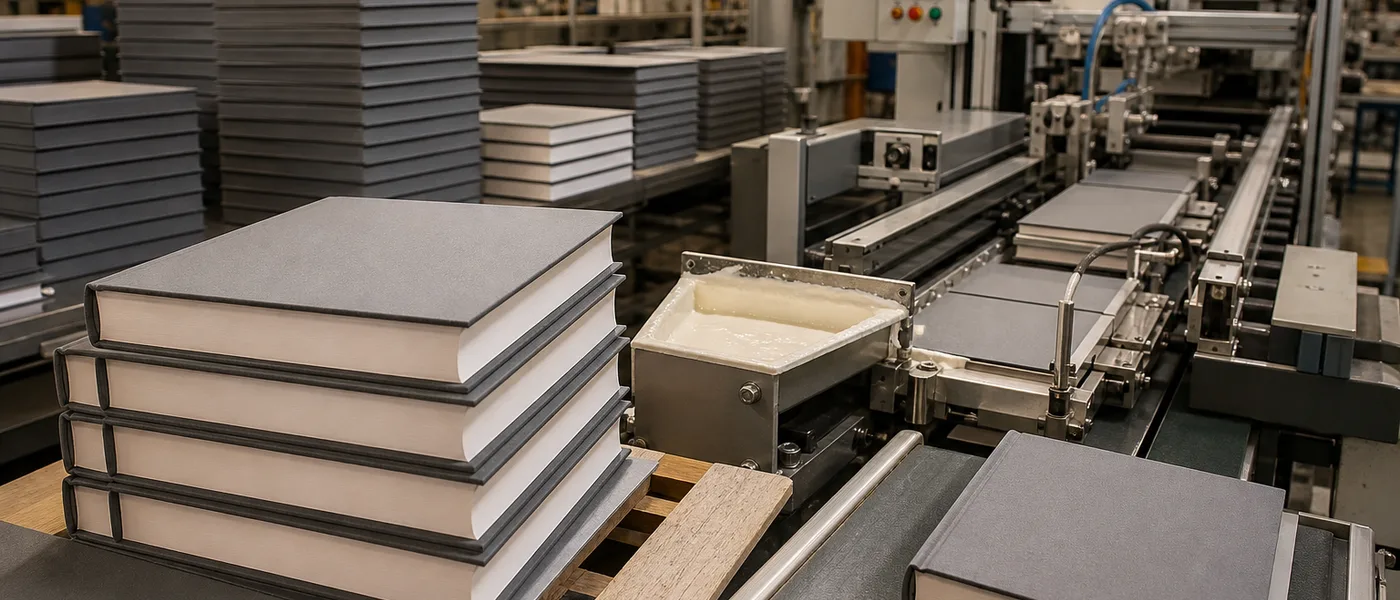
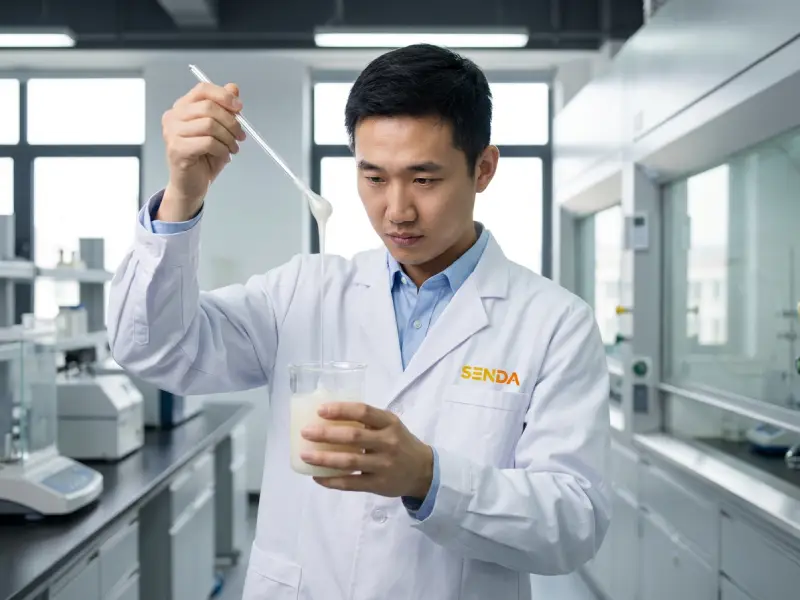
PUR perfect binding optimization should connect spine milling, notching, paper grain direction, glue pot temperature, moisture control, nozzle laydown, compression timing, and pull-strength validation before production approval. A useful trial proves the process window on real paper, cover stock, equipment, and book formats instead of promising universal speed or durability gains.
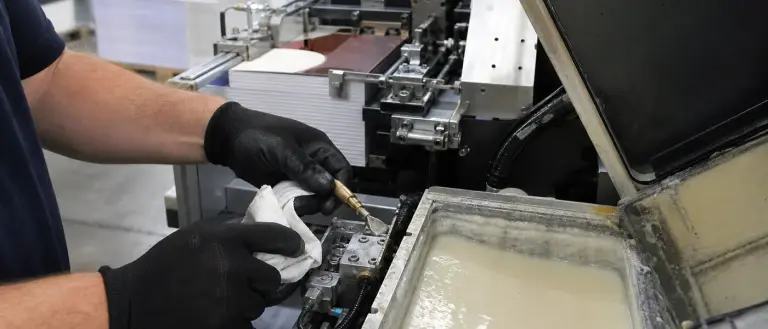
Table of Contents
- ·Why PUR Perfect Binding Approval Should Start With the Spine, Not Only the Glue
- ·Spine Milling, Notching, Dust Removal, and Paper Grain
- ·PUR Temperature, Moisture Control, Pot Life, and Line Start-Up
- ·Nozzle Discipline: Laydown, Bead Shape, Stringing, and Clean Edges
- ·Compression, Clamp Timing, Cover Fit, and Book Block Geometry
- ·Paper, Ink, Coating, and Cover Stock Variables
- ·Validation Tests: Pull Strength, Page Flex, Lay-Flat, Cold-Crack, and Aging
- ·Troubleshooting Common PUR Perfect Binding Defects
- ·Supplier Documents and Procurement Checks
- ·Build a Practical PUR Binding Trial Record
- ·Field Evidence
- ·Final Takeaway
- ·Frequently Asked Questions
Why PUR Perfect Binding Approval Should Start With the Spine, Not Only the Glue
PUR perfect binding is often discussed as an adhesive upgrade, especially when a bindery wants stronger page pull, better coated-stock performance, or a thinner glue line than a traditional EVA hot melt setup may provide. However, PUR success does not come from adhesive selection alone. It depends on the full binding system: book block preparation, paper grain direction, spine milling, notching, dust removal, glue pot condition, nozzle cleanliness, open time, set time, compression, cover fit, and final validation.
A common mistake is to compare PUR and EVA only by general strength claims. That is not enough for production approval. A PUR adhesive may be well matched to the job, but the book can still fail if the spine is polished, dusty, over-milled, under-notched, misaligned with grain direction, or compressed outside the correct timing window. Likewise, a book may show spine cracks or page pull failure because of nozzle streaks, partial ribs, pot contamination, moisture exposure, or poor start-up discipline.
The first approval question should be: Is the spine ready to receive PUR? If the spine does not expose usable fiber, if dust blocks wet-out, or if the paper grain creates lay-flat stress, the adhesive grade may be blamed for a process problem. This is especially true for coated papers, art books, heavy ink coverage, short-run book blocks, case-bound workflows, and books that will be shipped into cold regions.
A practical PUR perfect binding trial should answer these questions:
| Buyer Question | Qualification Focus |
|---|---|
| Is the spine prepared correctly? | Spine milling, notching, fiber exposure, dust removal |
| Is the paper stack suitable? | Grain direction, coated stock, ink coverage, caliper variation |
| Is the adhesive system stable? | Glue pot temperature, hose temperature, nozzle temperature, moisture control |
| Is laydown consistent? | Bead shape, rib pattern, glue coverage, stringing, clean edges |
| Is compression timed correctly? | Clamp pressure, cover fit, spine geometry, open time, set time |
| Is the result validated? | Pull strength, page flex, lay-flat, cold-crack, aging, handling |
For purchasing teams, the goal is not to approve PUR as a generic label. The goal is to approve a repeatable binding process on the actual book format, production line, and paper lot.
Spine Milling, Notching, Dust Removal, and Paper Grain
Spine preparation is the foundation of PUR perfect binding optimization. PUR needs access to paper fiber and a stable spine profile. If the spine is too smooth, too weak, dusty, or uneven, the adhesive cannot form a reliable bond through the full page block.
Spine milling removes the folded or cut edge and opens the paper structure. Notching adds mechanical anchorage and helps adhesive penetrate into the spine. The correct milling depth and notching pattern depend on book thickness, paper grade, coating level, page count, grain direction, and equipment setup. A light book on uncoated paper may not need the same preparation as a thick coated catalog or art book.
Dust removal is just as important as milling depth. Milling and notching can create paper dust and fiber debris. If dust remains on the spine, PUR may bond to the dust layer instead of the page fibers. That can cause weak pull strength, page release, or inconsistent failure patterns during flexing.
Paper grain direction should be checked early. Misaligned grain can create stiffness, wave, and lay-flat problems that look like adhesive weakness. A book may pass a basic pull test but still feel stiff, resist opening, or crack at the spine during repeated use. For art books, photography books, coated papers, and case-bound projects, grain direction should be part of the approval record.
| Spine Variable | Why It Matters | What to Record |
|---|---|---|
| Milling depth | Exposes fiber and removes weak edges | Machine setting, paper grade, book thickness |
| Notching pattern | Adds mechanical anchorage | Depth, spacing, tool condition |
| Dust removal | Prevents weak boundary layer | Vacuum, brush, air, inspection method |
| Paper grain direction | Affects lay-flat and spine stress | Grain direction vs. spine orientation |
| Coated stock behavior | Coating can reduce fiber exposure | Paper type, coating, ink coverage |
| Book block thickness | Changes glue demand and compression | Page count, caliper, spine width |
Do not approve a PUR grade on one paper lot and assume the result will repeat across every stock. When paper grade, coating, caliper, grain direction, or print coverage changes, the spine preparation window may need review.
PUR Temperature, Moisture Control, Pot Life, and Line Start-Up
PUR is a reactive hot melt system, so glue pot discipline matters. The adhesive must be kept inside the supplier’s recommended temperature and handling window. Overheating can accelerate skin formation, char, viscosity drift, and nozzle clogging. Underheating can reduce flow, affect laydown, and create uneven coverage.
Moisture control is also critical. PUR reacts with moisture during cure, but uncontrolled moisture exposure in the pot, hose, or open container can create premature reaction, skinning, gel particles, or unstable flow. Operators should follow the TDS and equipment guidance for storage, opening, melting, pot residence time, purging, and shutdown.
Line start-up deserves special attention. The first books after warm-up can reveal temperature drift, nozzle blockage, old material, or incomplete purge. A trial should not approve only the best books in the middle of the run. It should review start-up books, continuous-run books, stop-start books, and restart books after idle time.
| Glue System Item | Risk If Ignored | Trial Check |
|---|---|---|
| Glue pot temperature | Skinning, charring, viscosity change | Log setpoint and actual reading |
| Hose temperature | Flow drift or partial cooling | Record hose setpoint |
| Nozzle temperature | Streaks, tails, poor bead shape | Record nozzle setpoint |
| Moisture exposure | Premature reaction, gel, clogging | Control container opening and pot exposure |
| Pot life | Unstable adhesive during long runs | Track time at temperature |
| Purging plan | Old material contaminates trial | Record purge before start and after shutdown |
| Line start-up | First books may fail differently | Inspect early books separately |
If a bindery changes PUR grade, pot size, hose routing, nozzle type, or shutdown practice, the glue system should be reviewed again. A good PUR adhesive cannot overcome poor pot maintenance indefinitely.
Nozzle Discipline: Laydown, Bead Shape, Stringing, and Clean Edges
Nozzle discipline is one of the most visible parts of PUR perfect binding optimization. A clean and stable nozzle pattern supports consistent spine coverage. A dirty, clogged, overheated, or misaligned nozzle can create streaks, tails, skipped ribs, partial beads, or excess glue at the spine edge.
The adhesive pattern should match the book block and cover design. The goal is not simply to apply more PUR. Excess adhesive can create squeeze-out, dirty edges, stiff spine feel, longer set time, or cover problems. Too little adhesive can create poor page pull, weak side bonding, or local spine cracks. The correct laydown is the one that gives controlled coverage across the spine and supports the required pull and flex validation.
Stringing should be investigated rather than accepted as normal. It may be linked to temperature drift, nozzle contamination, distance from spine, adhesive viscosity, line speed, stop-start timing, or old material in the system. Stringing can lead to dirty books, glue threads, edge defects, and operator cleanup.
Important nozzle checks include:
| Nozzle Check | What to Look For |
|---|---|
| Bead continuity | No skipped ribs, streaks, or broken lines |
| Edge cleanliness | No excessive squeeze-out or glue tails |
| Spine coverage | Adhesive reaches required spine area |
| Side glue control | Cover hinge receives correct support where applicable |
| Restart behavior | No clogging, skin particles, or delayed flow |
| Nozzle cleaning | Cleaning interval is practical for the shift |
| Pattern repeatability | First, middle, and late-run books look consistent |
A nozzle problem can easily be misread as an adhesive weakness. If pull strength varies across the spine, inspect the laydown pattern before changing adhesive grade.
Compression, Clamp Timing, Cover Fit, and Book Block Geometry
Compression is the handoff between adhesive laydown and finished book structure. PUR needs the right contact between the prepared spine, glue film, and cover or spine lining. If compression is too light, the adhesive may not wet the paper and cover properly. If compression is too aggressive, glue may be displaced or the spine shape may be distorted.
Clamp timing matters because PUR has an open time and set time that must fit the equipment sequence. If the cover meets the spine too late, wet-out may be reduced. If the book is handled too early, the bond may be disturbed before enough handling strength develops. The correct window depends on adhesive grade, coat weight, paper, cover stock, book thickness, temperature, and line speed.
Cover fit is another common source of trouble. A cover that is too tight, too stiff, poorly scored, or mismatched to the book block can create hinge stress and spine cracks. Case-bound workflows may still depend on perfect-bound spine quality before casing-in, so the spine should be validated before the book moves to later finishing steps.
| Binding Variable | Possible Defect | First Check |
|---|---|---|
| Low compression | Weak wet-out, page pull failure | Clamp pressure and timing |
| Excess compression | Squeeze-out, stiff spine, edge glue | Pressure, glue amount, cover fit |
| Poor cover score | Hinge cracking, poor opening | Score position and cover stock |
| Thick book block | Uneven compression, glue demand shift | Spine width and clamp setup |
| Thin book block | Overcompression or glue visibility | Glue amount and nip control |
| Curved or uneven spine | Local weak areas | Book block preparation and clamp alignment |
A PUR trial should review multiple book formats when the buyer expects one adhesive system to cover several product types. Thin manuals, thick catalogs, coated art books, and case-bound book blocks may not share the same compression window.
Paper, Ink, Coating, and Cover Stock Variables
Paper and cover stock can change PUR binding performance even when the adhesive and machine settings stay the same. Coated paper, heavy ink coverage, varnish, lamination, high basis weight, low porosity, and caliper variation can affect fiber exposure and spine wet-out.
Coated stocks often require careful milling and notching because the surface layer may reduce fiber availability. If the spine is not opened enough, PUR may not anchor consistently. If the spine is over-weakened, the pages may tear or split during pull testing. The correct balance should be found through production paper trials.
Ink coverage near the spine can also matter. Heavy ink, coatings, varnishes, or contamination in the spine area can reduce adhesion. Print layout and trimming should be reviewed if failures repeat on certain signatures or page zones.
Cover stock affects hinge performance. A stiff or laminated cover may resist opening and transfer stress to the spine. A soft cover may compress differently. Score position, cover grain direction, hinge design, and side glue should be checked before blaming PUR.
| Material Variable | Why It Matters |
|---|---|
| Coated paper | May need more controlled fiber exposure |
| Heavy ink coverage | Can interfere near the spine if present |
| Paper caliper variation | Changes spine width and compression |
| Cover stiffness | Affects hinge and lay-flat feel |
| Cover lamination | Can change scoring and fold behavior |
| Grain direction | Influences opening behavior and spine stress |
| Storage humidity | Can change paper handling and book block shape |
For QA teams, every PUR trial should record paper lot and cover stock details. A passing result on one paper stock should not be stretched into a universal approval for all book formats.
Validation Tests: Pull Strength, Page Flex, Lay-Flat, Cold-Crack, and Aging
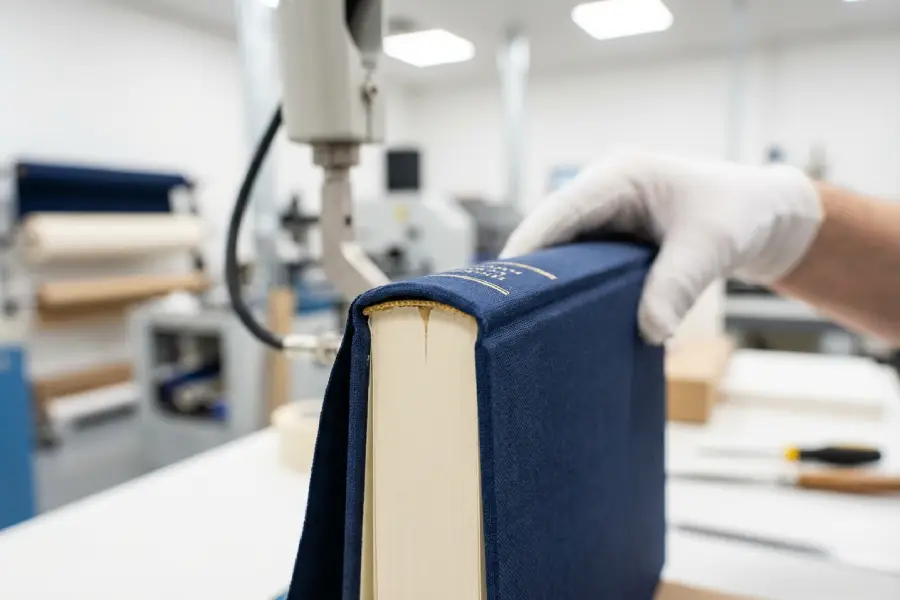
Validation should reflect how the finished book will be used, shipped, and judged. Pull strength is important, but it should not be the only approval test. A book may pass pull strength and still fail lay-flat expectations, crack in cold distribution, or show hinge issues after handling.
Pull testing should be performed on production paper lots and actual book formats. Record the test method, dwell time after binding, page location, direction of pull, and whether the failure occurs in paper fiber, adhesive, coating, or the spine structure. Pull strength numbers without test context are hard to compare.
Lay-flat review is important for manuals, art books, photography books, catalogs, and case-bound workflows. Poor lay-flat can come from paper grain direction, cover hinge design, spine stiffness, adhesive amount, or book geometry. It should not be attributed to adhesive grade alone.
Cold-crack review may be relevant when books ship into winter conditions or cold warehouses. A cold-crack check should be tied to the buyer’s expected storage and shipping conditions. Avoid broad cold-performance claims unless the test condition and result are clearly defined.
| Validation Area | What to Confirm |
|---|---|
| Pull strength | Page retention on actual paper and format |
| Page flex | Spine survives repeated opening and handling |
| Lay-flat | Opening behavior meets customer expectation |
| Cold-crack | Spine and cover behave under defined cold condition |
| Aging or conditioning | Result after rest period, humidity, or storage |
| Visual inspection | No glue streaks, tails, squeeze-out, or spine defects |
| Handling strength | Book can move through downstream steps safely |
Validation should be completed after the adhesive has had enough time to develop the expected bond. PUR curing continues after initial set, so testing too early may not represent final performance. The supplier’s TDS and the buyer’s QA method should guide timing.
Troubleshooting Common PUR Perfect Binding Defects
PUR binding defects usually have more than one possible cause. A troubleshooting table helps the team check the process before changing adhesive grade.
| Defect | Possible Causes | First Checks |
|---|---|---|
| Page pull failure | Poor milling, dust, low coverage, short compression | Spine prep, dust removal, nozzle pattern |
| Lay-flat failure | Grain direction, stiff cover, excess glue, hinge design | Paper grain, cover score, glue amount |
| Spine cracking | Nozzle streaks, brittle spine, cold exposure, poor cover fit | Laydown pattern, cold test, cover geometry |
| Glue stringing | Temperature drift, nozzle contamination, line speed mismatch | Pot/hose/nozzle setpoints, cleaning |
| Clogged nozzle | Skinning, overheated PUR, moisture exposure, old material | Pot life, purge routine, moisture control |
| Dirty edges | Excess laydown, tails, compression mismatch | Bead shape, nozzle condition, clamp pressure |
| Weak coated-stock bond | Low fiber exposure, dust, coating interference | Milling depth, notching, paper lot |
| Cover pull-away | Poor side glue, hinge stress, cover mismatch | Cover score, side glue pattern, compression |
| Variable pull results | Uneven spine prep or laydown | Spine photos, nozzle pattern, page location |
| Slow handling strength | Set time mismatch, temperature, glue amount | Open time, set time, line speed, dwell |
When troubleshooting, record where the failure occurs. Does the page tear? Does the adhesive release from the paper? Does the cover separate? Does the spine crack only after cold conditioning? Does the defect repeat near the head, tail, or center? These details help the supplier and bindery team identify the real correction.
Need a PUR Binding Trial Plan?
Share spine stock, cover stock, line setup, and validation target before sample approval.
Plan a Lab ReviewSupplier Documents and Procurement Checks
Purchasing should request supplier documents before approving PUR for routine production. These documents help production, QA, EHS, and purchasing teams review the same material.
The TDS should provide product guidance such as recommended application temperature, open time, set time, handling notes, storage recommendations, and cleaning or equipment guidance where available. The SDS should be reviewed for safe handling, storage, transport, and workplace communication. The product label and batch code should be kept with the trial record for traceability.
Commercial details also matter. MOQ, lead time, packaging format, shelf life, sample quantity, and equipment compatibility can affect production planning. A PUR grade may pass technically but still create problems if the packaging size does not fit pot usage, if lead time is too long, or if the bindery cannot maintain proper storage.
| Document or Check | Buyer Use |
|---|---|
| TDS | Application temperature, open time, set time, storage, use guidance |
| SDS | Safety, handling, PPE, storage, transport |
| Batch label | Trial traceability and quality review |
| Shelf-life guidance | Inventory and storage planning |
| MOQ | Purchasing approval and production planning |
| Lead time | Launch and reorder planning |
| Equipment notes | Pot, hose, nozzle, cleaning, purge considerations |
| Trial report | Links test result to paper, cover, machine, and settings |
Supplier documents support the trial, but they do not replace it. Final approval should still be based on the bindery’s real paper, cover stock, line setup, and validation target.
Build a Practical PUR Binding Trial Record
A good PUR trial record helps the bindery repeat the approved result. It also helps Senda or any adhesive supplier troubleshoot if the result changes later.
The trial should record the book format, paper stock, cover stock, spine preparation, glue system settings, line speed, compression, validation results, and observed defects. Photos are useful, especially of the milled spine, glue pattern, finished spine, pull-test failure surface, and any cracked or lifted areas.
| Trial Record Item | What to Capture |
|---|---|
| Book format | Trim size, page count, spine width, book type |
| Paper stock | Supplier, grade, coating, caliper, grain direction |
| Cover stock | Material, thickness, lamination, score, grain direction |
| Spine prep | Milling depth, notching pattern, dust removal |
| PUR grade | Supplier, product code, batch, TDS version |
| Glue system | Pot, hose, nozzle setpoints, purge routine |
| Laydown | Bead shape, coverage, glue amount, edge condition |
| Line speed | Trial speed and normal production speed |
| Open time/set time | Timing between laydown, cover application, handling |
| Compression | Clamp pressure, timing, alignment |
| Validation | Pull strength, flex, lay-flat, cold-crack, aging |
| Failure mode | Paper tear, adhesive release, cover lift, spine crack |
| Documents | TDS, SDS, batch label, MOQ, lead time |
The record should also state approval limits. For example, if the trial passed only on a specific coated paper and book thickness, do not automatically apply the approval to a thicker book, different paper grain direction, or another cover stock without review.
Field Evidence
Useful internal links to preserve or add where relevant:
Field evidence should be presented carefully. If a testimonial reports results such as 40 N/cm+ pull strength, fewer returns, or about 20% faster running, frame those numbers as a site-specific trial outcome under defined paper, spine preparation, equipment, and production conditions. They should not be presented as universal guarantees for every bindery or every book format.
A useful field evidence file may include:
| Evidence Type | Why It Helps |
|---|---|
| Paper and cover details | Confirms whether the trial matches the buyer’s job |
| Spine preparation photos | Shows milling, notching, and dust removal quality |
| Pot and nozzle logs | Confirms temperature and laydown stability |
| Pull test results | Connects strength to actual production paper |
| Lay-flat review | Shows finished book behavior |
| Cold-crack review | Supports winter or cold-chain distribution decisions |
| Failure photos | Helps identify adhesive, paper, spine, or cover failure |
| Known limits | Prevents overuse outside the qualified window |
Good field evidence is practical and specific. It should help a buyer decide whether to run a structured trial, not promise the same number on every line.
Final Takeaway
PUR perfect binding optimization is a process discipline. The adhesive grade matters, but it cannot replace correct spine preparation, paper grain control, glue pot maintenance, nozzle discipline, compression timing, and validation testing.
Before approving PUR for production, confirm the real book format, paper stock, cover stock, spine milling, notching, dust removal, glue pot settings, nozzle pattern, open time, set time, compression, and final validation. Use pull strength, page flex, lay-flat, cold-crack, and handling review to judge the complete system.
The best approval record does not simply say “PUR passed.” It says which PUR grade passed, on which paper, with which spine prep, on which line settings, under which validation method, and within which limits. That is the difference between a sample test and a production-ready binding window.
Frequently Asked Questions
Is PUR always better than EVA for perfect binding?
No. PUR and EVA hot melt systems have different strengths, handling needs, equipment requirements, and cost considerations. PUR may be preferred for certain coated papers, demanding pull strength targets, or thinner glue-line applications, but it still requires careful spine preparation, pot control, and validation. EVA may remain suitable for other book formats, production needs, or cost structures. The right choice should be tested on the actual paper, cover stock, and binding line.
What spine preparation details should be recorded during a PUR trial?
Record milling depth, notching pattern, tool condition, dust removal method, paper grade, coating level, grain direction, spine width, book thickness, and photos of the prepared spine. These details help explain pull strength, lay-flat behavior, and page retention results.
Why can a PUR-bound book fail even when the adhesive grade is correct?
A correct PUR grade can still fail if the spine is poorly milled, dust remains on the paper, paper grain direction is wrong, nozzle laydown is uneven, the glue pot overheats, moisture exposure causes skinning, compression is mistimed, or the cover hinge does not match the book geometry. Binding performance comes from the full process, not the adhesive alone.
How should a bindery control PUR pot life and moisture exposure?
Follow the supplier’s TDS and equipment guidance. Keep pot, hose, and nozzle temperatures inside the recommended range, limit open exposure, avoid leaving reactive PUR heated through long shutdowns without a plan, and document purge routines. Moisture and excessive heat can contribute to skinning, gel particles, and nozzle clogging.
What should be checked when PUR stringing or nozzle build-up appears?
Check pot, hose, and nozzle temperature, adhesive age in the system, nozzle cleanliness, purge routine, line speed, distance to the spine, and whether moisture exposure or skinning has occurred. Inspect the glue pattern on the spine before changing adhesive grade.
Which validation tests matter before production approval?
Common checks include pull strength, page flex, lay-flat behavior, visual spine inspection, cold-crack review where relevant, and aging or conditioning based on the buyer’s use case. The exact tests should match the book format, paper stock, cover stock, shipping route, and customer expectation.
When should a PUR binding system be requalified?
Requalify when the paper grade, coating, grain direction, cover stock, book thickness, spine milling, notching, glue pot setup, nozzle, line speed, compression, PUR grade, or validation target changes. Requalification is also recommended when a stable line begins showing page pull failures, spine cracks, stringing, or lay-flat complaints.
What documents should purchasing request from the adhesive supplier?
Purchasing should request the TDS, SDS, product label, batch code, storage guidance, shelf-life information, MOQ, lead time, and any equipment or cleaning notes relevant to the bindery’s PUR system. The trial report should stay with these documents for production approval.
Can Senda provide lab material for a PUR perfect binding trial?
Yes. Senda can review spine stock, cover stock, paper grade, line setup, glue pot conditions, nozzle type, validation targets, and production concerns before sample screening. A complimentary 1 kg lab material request can support early testing, but final approval should be based on the bindery’s actual line and qualification record.
Trial PUR binding on your line
Request complimentary 1 kg lab material, with shipping prepaid by the recipient, after screening your spine stock, cover stock, line setup, and validation target.
References
Technical Disclaimer: All technical data is based on standard laboratory conditions. Users should perform their own verification testing to confirm suitability for specific substrates, processes, and regulatory requirements. Senda Glue makes no warranties, express or implied, and assumes no liability for improper use of the products or reliance on this information.