Edge Protector Adhesive for V-Board & Ply Lamination

Factory-direct V-board glue and edge protector adhesive for V-profile, U-profile, and heavy-duty guards. Water-based VAE/PVA grades tuned for strap-tension and beam strength on your ply stack—1 kg lab screen, then 20 kg line trial.
*Complimentary 1 kg lab material · shipping prepaid by recipient. 20 kg pails for laminator trials after screening. MOQ typically ~1,000 kg.*
✅ Beam & strap tests on your board • 175.105 routes where packaging applies • Repulpable water-based options (mill-dependent)
Optimized For:
Beam-Qualified
3-point bend / strap tension on your ply build
Line-matched
Viscosity for your laminator speed & nip
Repulpable
Water-based routes—confirm at your mill
Profiles We Laminate On
V-board, U-channel, and heavy-wall guards need different open time, solids, and compression response—one edge board glue rarely fits every profile line.
V-Board & L-Profile
Ply bonding for 90° edge protection—screen delamination under strap tension, not just dry peel.
U-Profile Systems
Three-sided guards for doors and panels—green strength at the former to hold angles before full cure.
Heavy-Duty Guards
Thick-wall programs (~4 mm+) for stacking loads—match adhesive solids to nip pressure and oven capacity.
Curved & Roll-End Guards
Flexible bond lines for bending and wrapping—validate spring-back and ply slip on your radius tooling.
From Strapping Delamination to Qualified Beam
Edge protector failures usually show up as ply separation under strap load or soft corners in transit—not as a single lab peel number.
Common Failures
Delamination Under Strap Tension
Weak internal bond lets plies separate when pallets are strapped—rejections and customer damage claims follow.
Slow Drying & High Moisture
High add-on traps water between plies, extending oven time and making cut-to-stack timing unpredictable.
Soft Edges / Crushed Corners
Low stiffness fails in transit even when the line looked acceptable off the laminator.
Our Solution
High-Shear Ply Bonding
VAE/PVA systems screened for internal bond under your strapping scenario—not generic “high strength” labels.
High-Solid, Fast-Set Routes
Lower moisture carry-through where your oven allows—targets dry-to-cut stability without over-gluing.
Beam & Strap Protocol
3-point bend plus strap-tension checks aligned to how your customer qualifies protectors.
Lab Support for Edge Protector Lines
We test beam and strap behavior on your board—not brochure guarantees.
Beam Strength Screening
3-point bend and internal-bond checks tied to your ply count and paper grade.
Laminator Rheology Tuning
Slot, roller, or curtain coater fit at the speed range you nominate for production.
Strap-Tension Qualification
Visible ply integrity under strap load—the same failure mode as many field complaints.
Tune to Profile, Speed & Beam Target
Standard V-board, heavy-wall, and export/cold-chain programs need different solids and polymers—confirm on your laminator.
| Application | Technology | Viscosity (typical) | Engineering benefit |
|---|---|---|---|
| Standard V-board / L-profile | 500–1,500 cps | Water-based VAE / PVA | Balanced open time for your laminator speed window and fiber-tear targets. |
| Heavy-duty & high-speed | 1,000–3,000 cps | High-solid VAE / modified PVA | Stiffer ply bond for thick walls—reduce spring-back on heavy guards. |
| Cold-chain / export humidity | 800–2,000 cps | Specialized VAE / acrylic | Humidity and low-temp screening on your board—do not assume universal freezer ratings. |
Technology: 500–1,500 cps
Viscosity (typical): Water-based VAE / PVA
Engineering benefit: Balanced open time for your laminator speed window and fiber-tear targets.
Technology: 1,000–3,000 cps
Viscosity (typical): High-solid VAE / modified PVA
Engineering benefit: Stiffer ply bond for thick walls—reduce spring-back on heavy guards.
Technology: 800–2,000 cps
Viscosity (typical): Specialized VAE / acrylic
Engineering benefit: Humidity and low-temp screening on your board—do not assume universal freezer ratings.
Why Edge Protector Plants Shortlist Senda
Strap-qualified ply bonds, laminator-tuned V-board glue, and paperwork for packaging audits—without fixed % beam or speed claims on every line.
Strap & Beam Together
VAE/PVA Fit for Paper
Audit-Ready Documentation
Documentation for Packaging & Export Programs
Many edge protectors are secondary packaging—request statements scoped to 175.105 indirect routes where food-adjacent storage applies.
Compliance Scope (Confirm for Your Program)
Not every V-board program needs food-contact paperwork—nominate end use before you claim FDA or export readiness.
- FDA 175.105 ( Indirect food-packaging routes where applicable (structure-dependent) )
- REACH & RoHS ( SVHC statements on request )
- Repulpable routes ( Water-based options—mill and coating stack dependent )
Batch-level TDS, SDS, DoC, and CoA for the nominated grade—scoped to your edge-protector program.
Related Paper Converting Lines
Edge protectors share plants with honeycomb panels and paper cores—route each station to the right chemistry.


Strapping delamination was our top complaint until we qualified a higher-stiffness VAE on our heavy-duty V-board. Senda’s beam and strap protocol gave us customer-audit data—not just a lab peel number.
Technical Proof (Optional Reading)
Share with production engineering after you request samples. Primary path: lab screen + audit package via the buttons above.
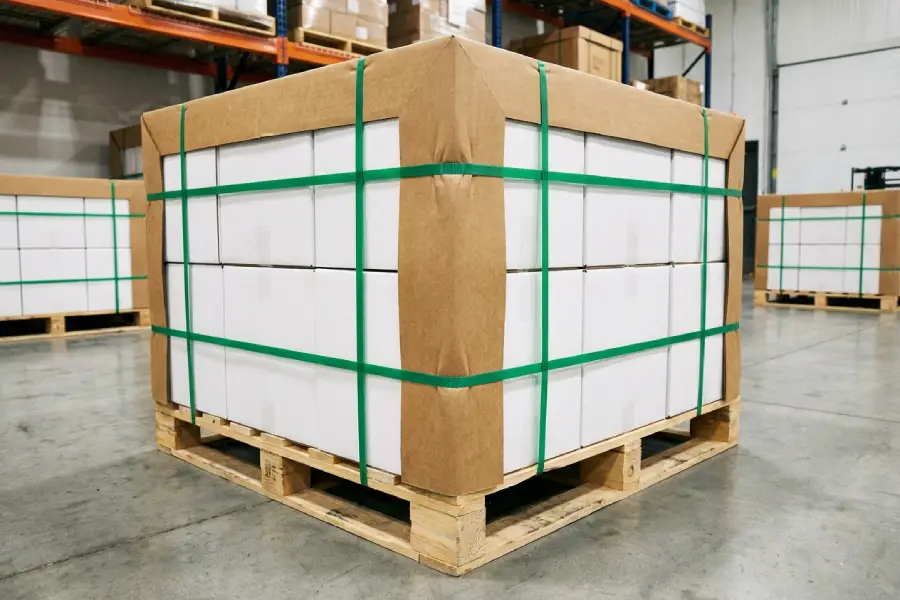 CASE STUDY
 Case Study: Strapping Delamination on V-Board
How a converter tightened lamination moisture and chemistry to stop ply separation under pallet strap tension.
Read the Full Story →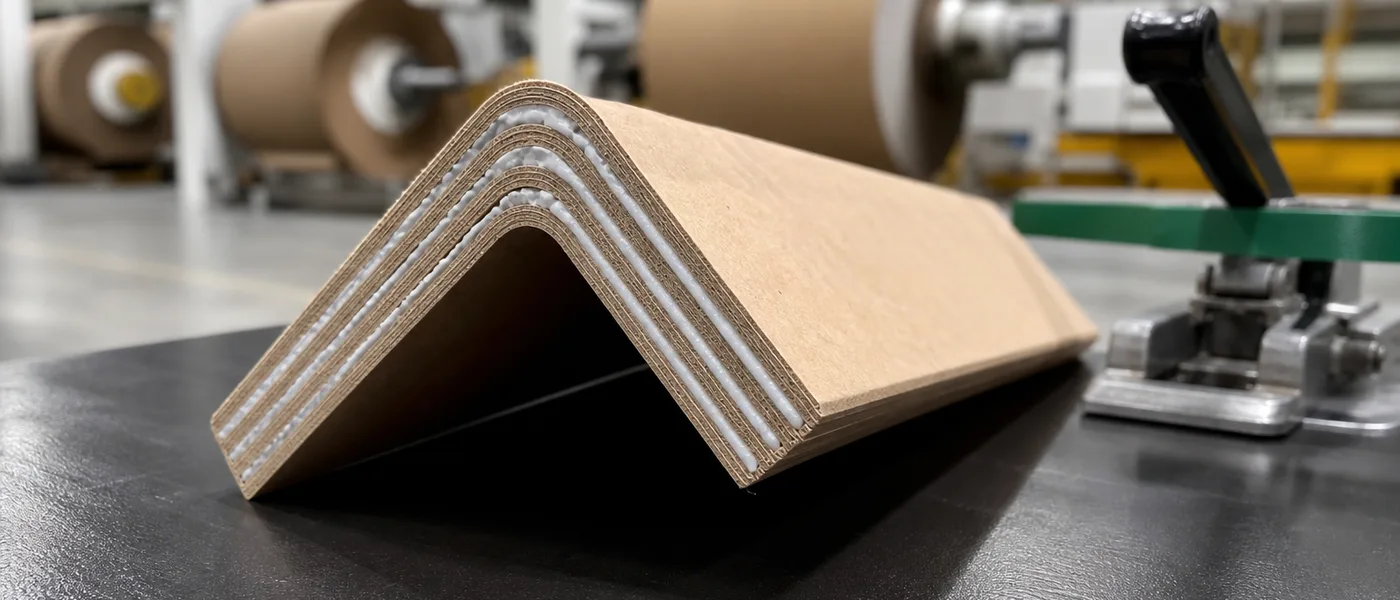 TECHNICAL GUIDE
 Guide: Maximizing V-Board Rigidity
Adhesive coverage, compression pressure, and paper grade selection for beam strength and strap performance.
Read Full Article →Frequently Asked Questions
Find answers to common questions about our adhesive solutions and services.
What adhesive is used for V-board edge protectors?
Most lines use water-based VAE or PVA ply-lamination adhesives. Grade choice depends on ply count, laminator speed, nip pressure, and strap-tension targets—start with a 1 kg sample on your board.
What are MOQ, lead time, and sample options?
MOQ is typically ~1,000 kg. Lead time is often 7–10 business days for qualified grades. Complimentary 1 kg lab material (recipient prepaid shipping), plus 20 kg pails for laminator validation.
Will this work for heavy-duty V-board under strapping?
Heavy-wall programs need higher solids and stiffer polymers—qualify with strap-tension and beam tests on your construction, not a generic “heavy-duty” label.
How do we validate whether the edge protector adhesive is repulpable in our paper structure?
Selected water-based routes are intended for fiber recovery—results depend on your mill, inks, and facings. Run an internal repulp test on the nominated grade.
Do you meet FDA or REACH requirements?
175.105 statements apply to some indirect packaging programs; REACH/RoHS docs are provided on request for nominated grades—include end use in your audit package.
How do coverage, nip pressure, and paper grade affect beam strength?
All three change stiffness as much as chemistry—see the V-board rigidity guide (Resources) before you only swap adhesive grade.
What laminator speeds do you support?
Speed limits are line-specific (applicator type, solids, oven). Share your m/min range; approve from trial data, not a marketing speed figure.
What shelf life and storage conditions should we plan for the approved grade?
Typically 6–12 months sealed at about 5–35°C—protect water-based grades from freezing; confirm on the TDS.